
What high-split is — and why this project exists
The plant was built for download. Customers now upload all day.
Legacy HFC (the coax network on strand and in easements) reserved a thin slice of spectrum for upstream — roughly 5–42 MHz going back toward the headend, and everything above ~54 MHz going downstream to the home. That was enough when the internet was mostly download.
Homes now send as much as they receive: video calls, cloud backup, cameras, gaming. That thin upstream slice is shared by every modem on the node. When it fills up, uploads crawl even if download still looks fine.
High-split moves the split point so upstream can run up toward ~204 MHz, with downstream starting higher (near ~258 MHz on a typical high-split class). Exact edges are on the node package — you do not guess them from the amp casting. The later High-Split Architecture module covers diplexers, BOM, and ingress in depth. This module is the job picture.
What “high-split” means on a truck
- Old plant (sub-split)
- Upload ~5–42 MHz · download from ~54 MHz — still on streets we have not converted
- What we are building
- Wider upload (high-split class ~5–204 MHz) so the node can carry modern DOCSIS traffic
- What has to change in the field
- Actives, diplexers, many taps/passives, and clean splices — one bad connector is louder on a wider return
- Why craft matters more
- Ingress and loose F-ports that were “good enough” on 42 MHz fail when upstream is three to five times wider
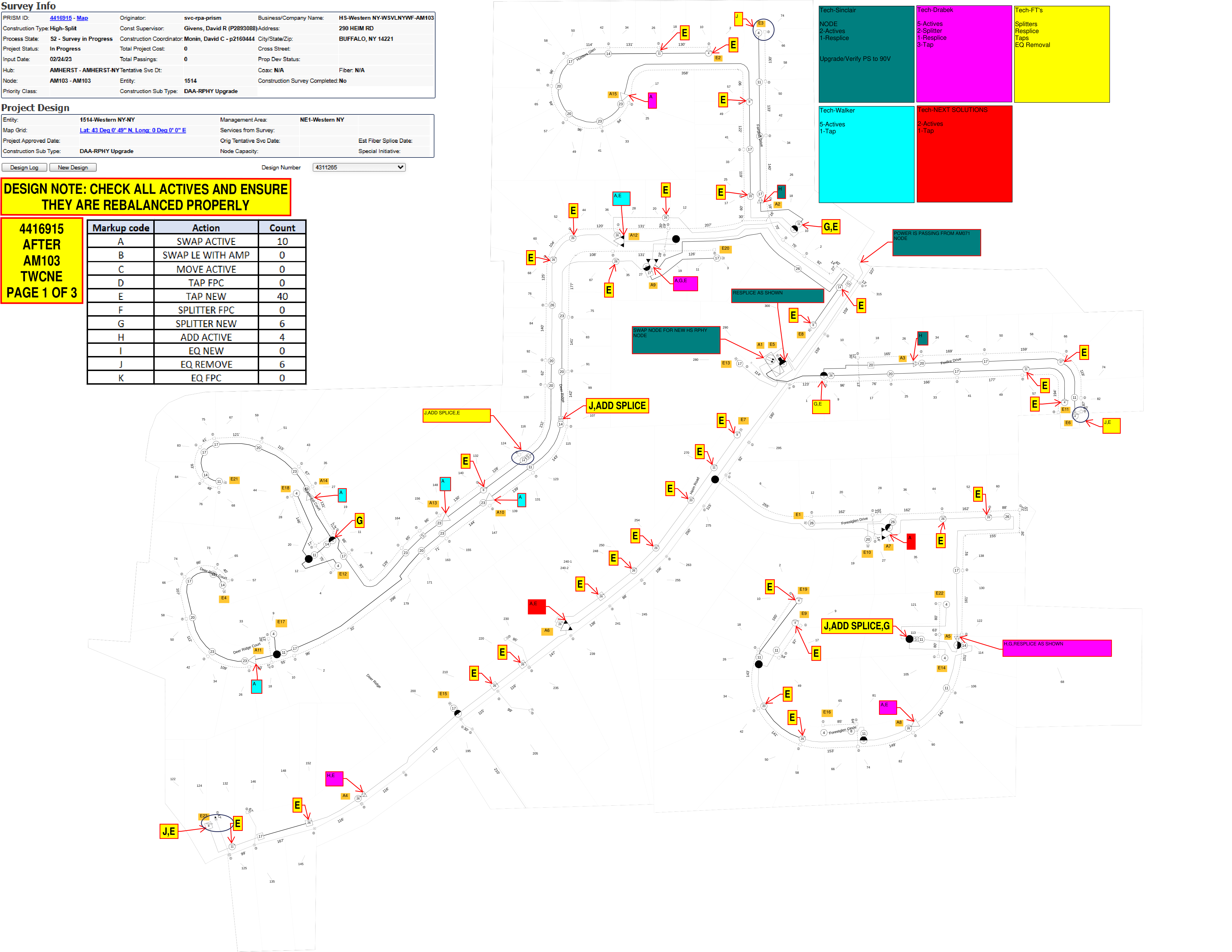
You need the picture: Spectrum is expanding upstream. FBR converts the coax plant to match that plan. Your ticket is a list of devices on a print — not a license to redesign the node.