
Tap Theory & Cascade Math
Role of the Directional Tap
A directional tap is a passive directional coupler on the hardline trunk. Most RF energy passes IN→OUT (through path) toward the next amplifier. A fixed fraction couples to drop port(s) facing customer pedestals.
Taps are directional — coupler geometry favors coupling toward drops and isolation in reverse on the through path. Installing backward reverses tilt and power-passing orientation.
Designers chain tap values so each pedestal receives target level while enough trunk energy remains for downstream taps and the next active device.
Through Loss vs Tap Loss
Tap value in dB (4, 7, 11, 15, 23, 26) describes coupling loss trunk→drop. Higher number = less energy to drop, more on trunk (lower through loss). Example: 11 dB tap ≈11 dB to drop and ~1 dB through; 23 dB tap ≈23 dB to drop and ~0.5 dB through (verify datasheet).
High tap values (23/26) early in a string where drop counts are low; lower values (4/7) near cascade end. Replacing 23 dB with 11 dB without engineering overdrives local drops and steals trunk level downstream — 'one street hot, rest cold.'
Cascade math: trunk level drops by cumulative through loss plus cable attenuation between taps. Drop level = trunk at tap minus tap coupling loss minus pedestal jumper loss.
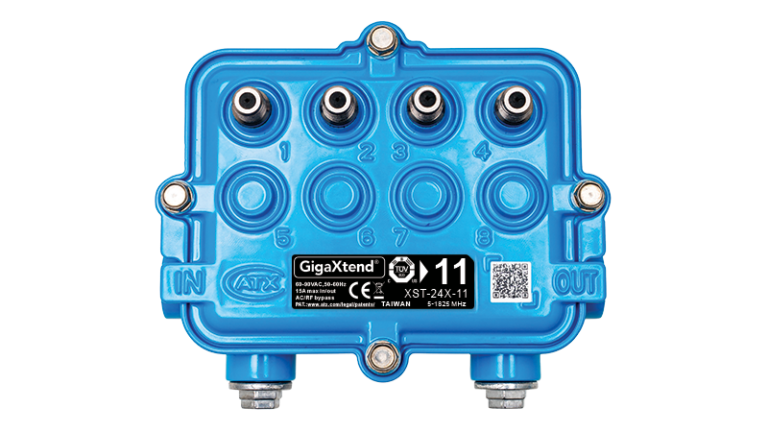
Reading the tap in the field
- IN arrow
- Trunk from node/upstream amp — match cascade direction
- OUT
- Through line continuing to the next tap/amp
- Drop ports
- To customers; terminate unused with 75 Ω
- Tap value
- dB coupling to drops — must match strand map
Tap terminology
- Through loss
- Trunk attenuation IN→OUT — lower on high-value taps
- Tap (coupling) loss
- Trunk-to-drop coupling — higher tap value = more loss to drop
- IN / OUT
- Trunk flow direction; must match cascade arrow on map
- Drop ports
- Feed pedestals; unused ports require 75 Ω terminators
- Power passing
- 15 A class typical on trunk taps feeding powered cascades
- 5–1225 MHz
- GigaXtend-class wideband for high-split field upgrades
Unterminated drop port = ingress entry on shared return. On high-split, one open 75 Ω port can degrade upstream SNR for the segment. Terminate before leaving pedestal.