
Coring Tools & Technique
Why Coring Quality Matters
Pin connectors depend on precise dielectric depth, clean outer conductor seizure, and uninterrupted center conductor contact. A bad core cannot be fixed with torque — over-tightening on a side-loaded core destroys threads and still leaves a weak RF joint.
Every trunk splice sits in the return-path noise funnel. Micro-gaps at the dielectric face cause sweep reflections and intermittent shield contact visible as ingress when weather changes. Treat coring as precision machining: square face, concentric conductor, spec depth, zero flood contamination.
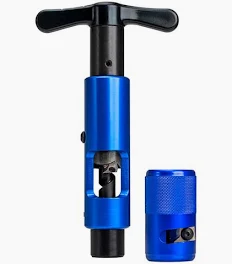
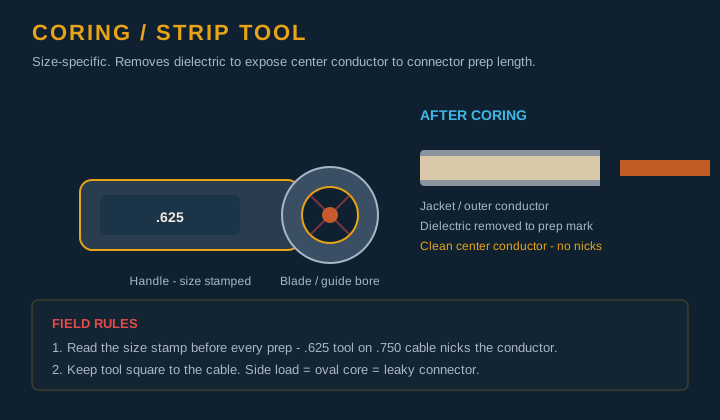
The size-matched coring / stripping tool prepping a hardline end in one pass — square seating, single-direction rotation, clean center conductor.
Coring Science & Blade Care
The mandrel inserts over the center conductor and centers the blade at the correct radius. The blade removes foam dielectric to a depth stop while protecting the conductor when used correctly. Impedance at the connector transition depends on dielectric diameter and concentricity — an eccentric core creates a local impedance bump.
Sharp blades cut clean foam without tearing. Dull blades tear dielectric, leave fuzz, and require extra rotation that increases side-load risk. Replace blade if resistance increases or dielectric looks ragged. Never use a utility knife or hack saw as substitute on trunk hardline.
Match mandrel stamp to cable size
Select a material, then its definition.
Materials
Definitions
Size stamps and mandrel ID
- .500 mandrel
- Stamped for P3/500 series — smallest OD mandrel set
- .625 mandrel
- Most common field size — verify stamp before use
- .750 mandrel
- Larger body — will not seat correctly on .625 cable
- .875 mandrel
- Largest common trunk — dedicated blade depth stop
- Rule
- Mandrel stamp must match jacket print / caliper verification